
CloudBank Research is a service-based platform that enables access to commercial cloud resources using a flexible, multi-cloud infrastructure. The platform currently supports the following commercial clouds: AWS, Google Cloud, IBM Cloud, and Microsoft Azure.
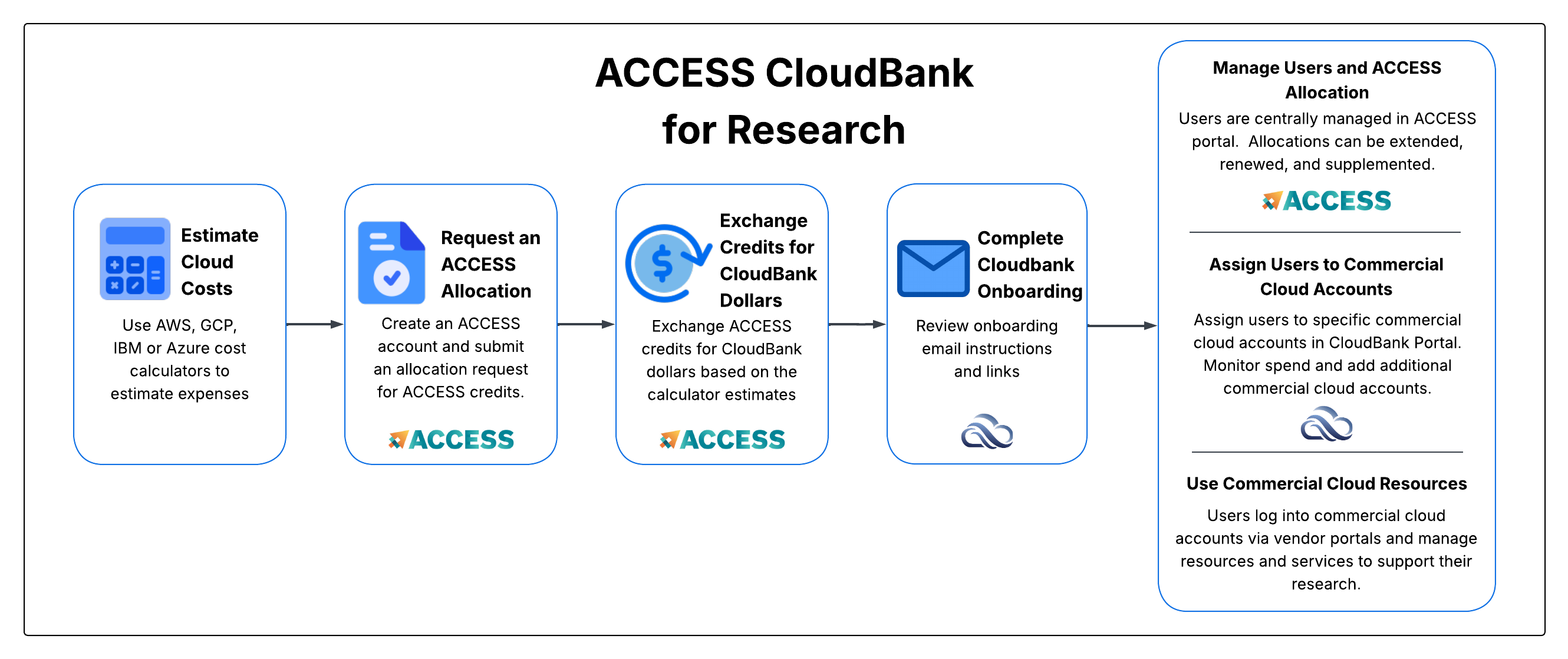
U.S.-based researchers can request access to CloudBank through the ACCESS program. The prerequisites are listed below, and the steps are summarized in the image below:
Prerequisites
- Cloud Cost Estimate:
- Use one or more of the supported cloud providers’ cost calculators to estimate your expenses: AWS, Google Cloud, IBM Cloud, Oracle Cloud, Microsoft Azure
- View Cost Estimate Best Practices
- Need help getting started? Watch our Cloud 101 videos to learn more about commercial cloud resources.
- Identify your ACCESS allocation type:
The ACCESS Allocation types and available funding amounts are:- Explore: Up to $10,000 per year
- Discover: Up to $37,500 per year
- Accelerate or Maximize: Up to $75,000 per year
- Supporting grant information: If you have a funding award associated with the work you plan to pursue, please have the grant number handy.
- CV or resume(s): All requests need a CV or resume (max 3 pages) for the project lead (PI) and any co-leads (Co-PIs).
Get Started
Request Your ACCESS Allocation (Guide)
Special note for existing CloudBank researchers: please create your ACCESS account using the same email you currently use for CloudBank.
Supported Commercial Clouds
 Amazon Web Services
AWS enables researchers to analyze massive data pipelines, store petabytes of data, and advance research with transformative technologies collaboratively and securely. Researchers can access HPC and AI/ML optimized compute across over 900 generally available instances with Amazon EC2, high performance storage services designed for AI/ML and simulation, end to end model training and deployment with Amazon SageMaker Unified Studio, quantum computers and circuit simulators with Amazon Braket, and foundation models from leading AI companies to build and scale generative AI applications and agents with Amazon Bedrock
 Google Cloud
Google Cloud is uniquely positioned to empower researchers tackling complex, data-intensive projects. Its full-stack AI infrastructure, including advanced Gemini models, is optimized for performance, offering elastic compute resources like GPUs and TPUs. Researchers benefit from BigQuery for fast, serverless analytics, Cloud Storage for scalable object storage, and Vertex AI for building and deploying machine learning models. This comprehensive environment, further supported by Cloud Functions for event-driven computing and Google Quantum AI for cutting-edge research, is purpose-built to accelerate scientific discovery.
 IBM Cloud
IBM Cloud emphasizes hybrid cloud solutions and quantum computing, appealing to researchers in fields like cryptography, materials science, and complex systems modeling. It offers IBM Cloud Object Storage for reliable data archiving, IBM Watson Studio for collaborative data science workflows, IBM Cloud Functions for serverless task execution, Red Hat OpenShift on IBM Cloud for managing containerized applications, and IBM Quantum for open access to quantum systems and tools for algorithm development.
 Oracle Cloud Infrastructure (estimated 2026)
Oracle Cloud Infrastructure (OCI) for Research Computing provides high-performance, scalable, and cost-effective cloud solutions tailored to the needs of academic, scientific, and industrial research. OCI supports compute-intensive workloads with powerful bare metal and GPU instances, high-throughput networking, and flexible storage options, making it ideal for simulations, data analysis, AI/ML training, and genomics. Researchers benefit from secure, compliant infrastructure, open standards, and integration with popular open-source tools.
 Microsoft Azure
Microsoft Azure delivers a versatile cloud platform with strengths in data management, scalable computing, integrated analytics, and AI for science offerings. For data storage, researchers can use Blob Storage and Data Lake for secure, scalable storage of large datasets. Integrated analytics offerings include Synapse or Stream Analytics, Databricks, and Data Lake Analytics for big-data workloads. AI offerings include the AI Foundry model catalog, OpenAI Service, and AI Search for intelligent retrieval. Researchers can also benefit from agentic AI for Science offerings including multi-agent orchestration via AI Foundry, libraries like AutoGen for complex R&D workflows, and the Microsoft Discovery platform for scientific workflow automation for literature mining, hypothesis generation, and simulation. Together, these offerings accelerate research with secure, scalable, and AI-driven solutions.